
ChatGPT for Marketing Teams — The Complete Guide (2026)
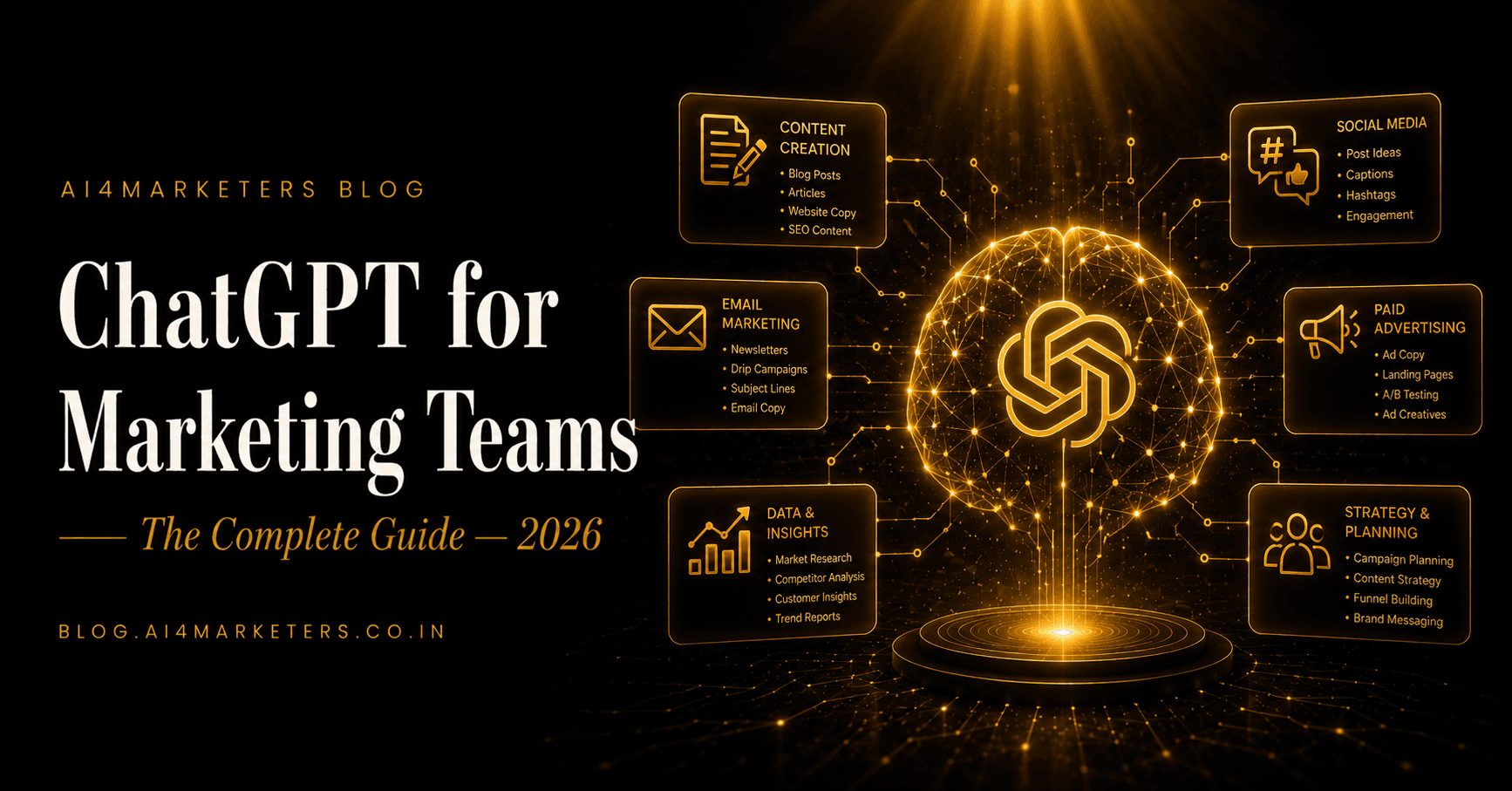
ChatGPT has become the most widely used AI tool in marketing.But most marketing teams are using it at 20% of its capability.
They use it to write a caption here, draft an email there — and then wonder why they're not seeing the productivity gains everyone talks about.
The difference between teams getting 10x output from ChatGPT and teams that aren't isn't the tool. It's the approach.
This is the complete guide to using ChatGPT for marketing teams in 2026 — covering every use case, with real prompts, workflows, and practical frameworks your team can implement immediately.
Table of Contents
- Why ChatGPT Matters for Marketing Teams in 2026
- Setting Up ChatGPT for Your Marketing Team
- Content Marketing with ChatGPT
- Social Media Marketing with ChatGPT
- Email Marketing with ChatGPT
- SEO and Content Strategy with ChatGPT
- Advertising and Paid Media with ChatGPT
- Brand Strategy and Positioning with ChatGPT
- Data Analysis and Reporting with ChatGPT
- Building a Marketing Prompt Library
- ChatGPT for Indian Marketing Teams
- Common Mistakes Marketing Teams Make
- Building a ChatGPT Workflow for Your Team
1. Why ChatGPT Matters for Marketing Teams in 2026
Marketing teams face a paradox in 2026.
Expectations have never been higher — more content, more channels, more personalization, faster turnaround — but headcount and budgets remain flat or are shrinking.
AI is the only realistic solution.
55% of marketers say content creation is their primary AI use case. — HubSpot
78% of organizations now use AI in at least one business function. — McKinsey
The marketing teams winning in 2026 aren't the ones with the biggest budgets. They're the ones that have figured out how to use AI as a force multiplier — producing more, faster, without sacrificing quality.
ChatGPT is the foundation of that stack.
2. Setting Up ChatGPT for Your Marketing Team
Before your team writes a single prompt, get the foundation right.
Choose the Right Plan
| Plan | Price | Best For |
|---|---|---|
| Free | $0 | Solo marketers, testing |
| ChatGPT Plus | $20/month | Individual marketers |
| ChatGPT Team | ~$25/user/month | Marketing teams of 3+ |
| Enterprise | Custom | Large organizations |
For most marketing teams, ChatGPT Team is the right choice. It includes shared workspaces, custom GPTs, and higher usage limits.
Create a Brand Context Document
Before using ChatGPT for any marketing task, create a master brand context document. Paste this at the start of every new conversation:
Brand context for all tasks in this conversation:

Brand name: [name]
What we do: [describe in one sentence]
Target audience: [describe in detail — job title,
  age, goals, pain points]
Brand tone: [3 adjectives — e.g. bold, warm, direct]
Key differentiators: [what makes you different]
Things to avoid: [words, phrases, or topics to skip]
Example of copy we love: [paste 1-2 examples]
This single step eliminates 80% of editing time.
Set Up Custom GPTs
ChatGPT Team allows you to create custom GPTs — specialized AI assistants trained on your brand guidelines, tone of voice, and marketing frameworks.
Create one custom GPT for each major function:
- Content GPT — trained on your blog style, tone, and past articles
- Social Media GPT — trained on caption examples and brand voice
- Email GPT — trained on your email templates and conversion principles
- SEO GPT — trained on your keyword strategy and content briefs
3. Content Marketing with ChatGPT
Content is where ChatGPT delivers the most immediate value for marketing teams.
Blog Post Creation Workflow
Step 1 — Keyword and angle
I want to write a blog post targeting the keyword
"[keyword]".

My audience: [describe].
Brand: [name].

Generate 5 unique angles for this post that would
stand out from existing content on Google.
For each angle include:
- The hook
- Why it would rank
- Why the audience would share it
Step 2 — Outline
Using angle [X] from above, create a detailed
blog post outline.

Include:
- H1 title (SEO optimized, under 65 chars)
- Meta description (under 150 chars)
- H2 sections with H3 subsections
- Key points to cover in each section
- Suggested word count per section
- Internal link opportunities

Total target: [word count].
Step 3 — Write section by section
Write the [introduction / section name] for this
blog post.

Use the outline above.
Tone: [describe].
Start with a hook — not a definition, not a
generic statement.
Under [X] words.
Step 4 — Meta and SEO elements
For the blog post above, write:
1. SEO title (under 60 chars, include keyword)
2. Meta description (under 150 chars, include keyword)
3. 5 relevant tags
4. 3 internal link suggestions based on these
   topics: [list your existing content]
5. FAQ section with 5 questions and answers
Content Repurposing Workflow
One of the highest-ROI uses of ChatGPT for marketing teams is repurposing existing content.
I have a blog post about [topic]. Here it is:
[paste blog post]

Repurpose this into:
1. 5 LinkedIn post variations (200-300 words each)
2. 10 Instagram captions (under 150 chars each)
3. 3 email newsletter sections (100 words each)
4. 1 Twitter/X thread (8-10 tweets)
5. 5 short-form video script hooks (under 30 secs)

Keep the core insights but adapt the format and
tone for each platform.
Brand tone: [describe].
4. Social Media Marketing with ChatGPT
Monthly Content Calendar
Create a 30-day social media content calendar for
[brand name].

Audience: [describe].
Platforms: [Instagram / LinkedIn / X].
Brand tone: [describe].
Content pillars: [list 4-5 themes].

For each day include:
- Date
- Platform
- Content type (carousel / reel / static / story)
- Caption hook (first line only)
- Content angle

Format as a table.
Caption Generation at Scale
Using this content calendar entry:
[paste specific day's entry]

Write 3 caption variations:
1. Storytelling approach (150-200 words)
2. Educational approach (bullet points, under 100 words)
3. Engagement approach (question-based, under 80 words)

Each must:
- Start with a scroll-stopping first line
- Include a clear CTA
- End with 5 relevant hashtags

Brand tone: [describe].
Audience: [describe].
Platform-Specific Content
LinkedIn thought leadership:
Write a LinkedIn post sharing my perspective on
[topic/trend in your industry].

My position: [your opinion].
Supporting points: [2-3 reasons].

Structure:
- Bold opening statement (1 line)
- 3-4 short paragraphs expanding the point
- Practical takeaway for [audience]
- Closing question to drive comments

Under 250 words. No hashtag overload — max 3.
Tone: [confident/direct/warm].
Instagram Reels script:
Write a 60-second Reels script about [topic].
Audience: [describe].

Structure:
- Hook (0-3 seconds): [bold statement or question]
- Problem (3-15 seconds): relatable pain point
- Solution (15-45 seconds): 3 quick tips
- CTA (45-60 seconds): follow / save / comment

Include on-screen text suggestions and
voiceover script separately.
Tone: [describe].
5. Email Marketing with ChatGPT
→ For 40+ ready-to-use email prompts, see our dedicated guide: ChatGPT Prompts for Email Marketing
Core Email Workflows
Subject line testing:
Write 10 subject line variations for an email about
[topic/offer].
Audience: [describe].

Include:
- 3 curiosity-based
- 3 benefit-driven
- 2 urgency-based
- 2 question-based

Mark your top 2 picks for A/B testing and explain why.
All under 50 characters.
Complete campaign brief to execution:
Create a complete email campaign for [goal].

Campaign details:
- Audience: [describe]
- Offer: [describe]
- Timeline: [X days]
- Number of emails: [X]

For each email provide:
- Send timing
- Subject line (2 options)
- Preview text
- Full body copy
- Primary CTA

Tone: [describe].
6. SEO and Content Strategy with ChatGPT
Keyword Clustering
I'm building a content cluster around the topic
"[main topic]".

My audience: [describe].
My website: [describe what you do].

Generate:
1. A pillar page topic with H1 suggestion
2. 15 supporting blog post topics that cover
   subtopics and long-tail keywords
3. For each post: suggested slug, target keyword,
   and search intent (informational/commercial/
   transactional)

Format as a table.
Content Brief Generation
Create a detailed SEO content brief for a blog
post targeting "[keyword]".

Include:
- Target keyword and 5 secondary keywords
- Search intent
- Recommended word count
- H1 and H2 structure
- Key questions to answer
- Competitor angles to differentiate from
- Suggested internal links
- Suggested external sources to reference
- Meta title and description
- FAQ section outline

Audience: [describe].
Brand: [name].
Meta Description Optimization
Write 5 meta description variations for a page about
[topic].

Requirements:
- Under 150 characters each
- Include keyword: [keyword]
- Drive clicks — not just describe the page
- Create curiosity or promise a clear benefit

Rank them from most to least likely to get clicks
and explain why.
7. Advertising and Paid Media with ChatGPT
Google Ads Copy
Write Google Search ad copy for [product/service].
Target keyword: [keyword].
Landing page goal: [describe].

For each ad write:
- Headline 1 (under 30 chars)
- Headline 2 (under 30 chars)
- Headline 3 (under 30 chars)
- Description 1 (under 90 chars)
- Description 2 (under 90 chars)

Create 3 ad variations:
1. Benefit-focused
2. Problem/solution
3. Social proof / authority

Include keyword in at least one headline per ad.
Meta/Facebook Ad Copy
Write Facebook/Instagram ad copy for [offer].
Audience: [describe in detail].
Objective: [awareness/leads/conversions].
Budget level: [testing/scaling].

For each ad write:
- Primary text (under 125 chars for mobile)
- Headline (under 40 chars)
- Description (under 30 chars)
- CTA button recommendation

Create 3 variations:
1. Emotional/story angle
2. Direct/benefit angle
3. Social proof angle

Avoid: [list things that don't resonate with your audience].
Ad Creative Concepts
Generate 5 ad creative concepts for [campaign].
Audience: [describe].
Platform: [Instagram/LinkedIn/YouTube].

For each concept describe:
- Visual idea (what should be shown)
- Hook text (overlay text on the creative)
- Emotion being targeted
- Why this would stop the scroll

Keep concepts distinct — different emotions,
different formats.
8. Brand Strategy and Positioning with ChatGPT
Positioning Statement
Help me develop a positioning statement for [brand].

Context:
- What we do: [describe]
- Target customer: [describe]
- Key benefit: [describe]
- Main competitors: [list]
- What makes us different: [describe]

Generate:
1. A classic positioning statement
   (For [audience] who [need], [brand] is the
   [category] that [benefit] because [reason])
2. A one-line brand promise
3. A tagline (under 6 words)
4. An elevator pitch (30 seconds)
Messaging Framework
Create a messaging framework for [brand/campaign].

Include:
- Core value proposition (1 sentence)
- 3 key messages (one per audience segment)
- Proof points for each message
- Tone of voice guidelines (5 dos and 5 don'ts)
- Words to use
- Words to avoid

Audience segments:
1. [segment 1]
2. [segment 2]
3. [segment 3]
9. Data Analysis and Reporting with ChatGPT
ChatGPT's Advanced Data Analysis feature allows marketers to upload reports and get instant insights.
Upload and Analyze
Upload your CSV or Excel report and use these prompts:
I've uploaded our [monthly campaign / social media /
email marketing] report.

Analyze the data and provide:
1. Top 3 insights from this data
2. What's working well (with specific numbers)
3. What needs improvement (with specific numbers)
4. 3 actionable recommendations for next month
5. Any anomalies or surprises in the data

Format as an executive summary I can share with
leadership.
Report Writing
Based on the analysis above, write a monthly
marketing performance report.

Include:
- Executive summary (3 sentences)
- Key metrics table
- Performance highlights
- Areas of concern
- Recommended actions
- Next month's priorities

Tone: professional but clear — written for
a CMO who is time-poor.
Under 500 words.
10. Building a Marketing Prompt Library
The most productive marketing teams don't start from scratch every time. They build a prompt library.
How to Structure Your Prompt Library
Create a shared document (Notion, Google Docs, or Confluence) with these sections:
Section 1 — Brand Foundation
- Brand context prompt (master template)
- Tone of voice examples
- Audience descriptions
Section 2 — Content Prompts
- Blog post workflow (Steps 1-4)
- Content repurposing prompt
- Content brief generator
Section 3 — Social Media Prompts
- Caption prompts by platform
- Content calendar prompt
- Hashtag research prompt
Section 4 — Email Prompts
- Subject line generator
- Welcome email template
- Nurture sequence builder
Section 5 — SEO Prompts
- Keyword clustering
- Meta descriptions
- Content brief
Section 6 — Ads Prompts
- Google Ads copy
- Meta Ads copy
- Creative concepts
→ For a ready-to-use Instagram prompt library, see: Top ChatGPT Prompts for Instagram Captions
11. ChatGPT for Indian Marketing Teams
India is the world's fastest-growing AI adoption market.
80% of Indian employees use AI weekly. — ADP Research
For Indian marketing teams specifically, ChatGPT offers advantages that go beyond standard content creation.
Hinglish Content
Write an Instagram caption for [brand] in Hinglish —
a natural mix of Hindi and English as spoken by
urban Indians aged 22-35.

Brand: [describe].
Product: [describe].
Tone: [casual/aspirational/humorous].
Avoid: forced translations that don't sound natural.

Write 3 variations.
Festival Marketing
Create a [Diwali/Holi/Eid/Independence Day]
marketing campaign for [brand].

Audience: [describe].
Tone: [festive/emotional/celebratory].

Include:
- Campaign concept (1 paragraph)
- 5 social media captions
- 1 email subject line and preview text
- 2 WhatsApp message templates

Keep cultural context authentic — not generic.
Regional Market Adaptation
Adapt this marketing copy for the [Tamil Nadu /
Maharashtra / Gujarat / Punjab] market.

Original copy: [paste]

Consider:
- Regional cultural nuances
- Local preferences and sensitivities
- Whether to include any regional language phrases
- Relevant local references or contexts

Provide the adapted version with notes explaining
key changes.
12. Common Mistakes Marketing Teams Make with ChatGPT
Mistake 1 — Generic Prompts
Wrong:
Write a social media post about our product.
Right:
Write an Instagram caption for [brand name], a
premium skincare brand targeting Indian women
aged 25-40. Product: [product name and benefit].
Tone: confident and luxurious. Hook with a
relatable skin concern. CTA: link in bio.
Under 150 characters. Include 5 hashtags.
Mistake 2 — Not Providing Brand Context
ChatGPT doesn't know your brand. Without context, every output sounds like a generic marketing agency wrote it.
Always paste your brand context document at the start of every new session.
Mistake 3 — Accepting the First Output
The first output is a draft. Iterate:
This is good but the hook is too weak.
Rewrite just the first line — make it more
provocative and specific to [audience pain point].
The CTA is too pushy. Make it feel more natural
and less salesy while still driving the same action.
Give me 5 alternative versions of just the headline.
Mistake 4 — Using ChatGPT as a Replacement for Strategy
ChatGPT executes brilliantly. It doesn't strategize brilliantly.
Use it for:
- ✅ Writing, editing, formatting
- ✅ Generating options and variations
- ✅ Repurposing existing content
- ✅ Analyzing data you provide
Don't rely on it for:
- ❌ Original market research
- ❌ Audience insights without data
- ❌ Strategic decisions
Mistake 5 — No Team Prompt Library
If every team member starts from scratch every day, you're losing hours per week. Build a shared prompt library and make it part of your marketing SOPs.
13. Building a ChatGPT Workflow for Your Team
30-Day Implementation Plan
Week 1 — Foundation
- Set up ChatGPT Team account
- Create brand context document
- Build basic prompt library (10 prompts)
- Train team on prompt writing basics
Week 2 — Content
- Implement blog post workflow
- Set up content repurposing system
- Build social media caption templates
Week 3 — Campaigns
- Implement email campaign workflow
- Build ad copy templates
- Create campaign brief generator
Week 4 — Optimize
- Review outputs — what's working, what needs refinement
- Update prompt library based on learnings
- Create custom GPTs for top use cases
- Measure time saved vs. previous month
Measuring ROI
Track these metrics monthly:
| Metric | Before AI | After AI | Change |
|---|---|---|---|
| Blog posts per month | |||
| Time per blog post | |||
| Social posts per week | |||
| Email campaigns per month | |||
| Content team hours saved |
Most marketing teams report 40-60% reduction in content production time within the first 30 days of systematic ChatGPT implementation.
Key Takeaways
- ChatGPT is most powerful when given complete brand context
- Build a shared prompt library — don't let each team member start from scratch
- Use ChatGPT for execution, not strategy
- Iterate on every output — the first draft is always improvable
- Measure time saved and content output monthly
- Indian marketing teams have specific advantages — Hinglish, festival content, regional adaptation
Explore the Full ChatGPT Prompt Library
This guide references several specialized prompt collections:
- ChatGPT Prompts for Instagram Captions — 30+ ready-to-use prompts
- ChatGPT Prompts for Email Marketing — 40+ email prompts
- ChatGPT vs Gemini for Marketers — Which tool wins?
- Best AI Tools for Social Media Marketing — Full stack guide
Want your marketing team to implement these workflows with hands-on guidance?
Request the AI4Marketers Workshop → ai4marketers.co.in
A 1-day hands-on workshop covering ChatGPT and 25+ AI tools with real marketing outputs. Trusted by Zomato, AB InBev, TVS Motors & IIM Indore.
Written by Sai Ganesh — AI trainer for marketing teams. Follow on X · LinkedIn · Instagram