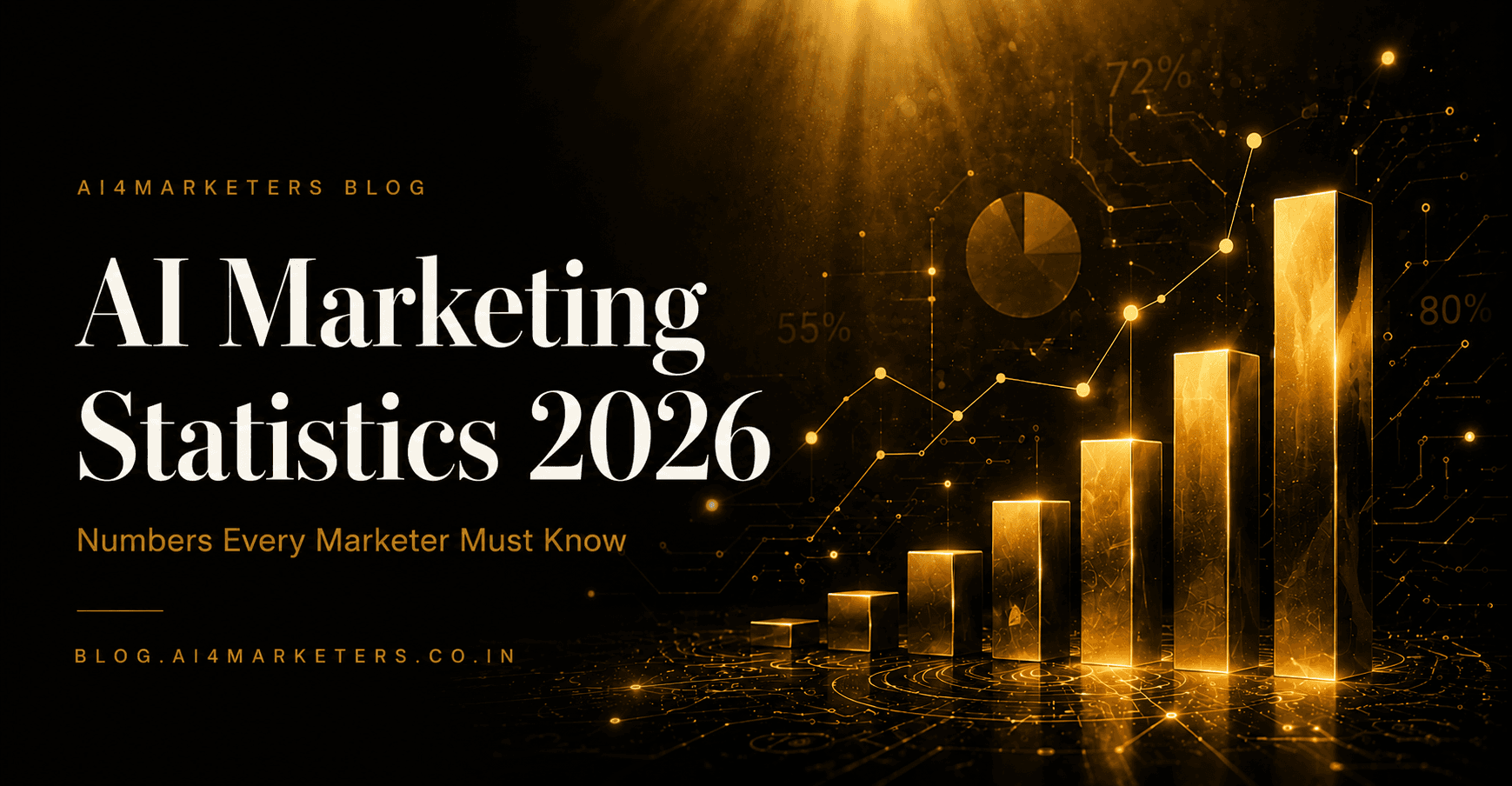
AI Marketing Statistics 2026 — Numbers Every Marketer Must Know
Artificial intelligence has moved from experimentation to execution. In 2026, AI is helping marketers create content faster, personalize customer experiences at scale, automate repetitive workflows, optimize ad spending, and uncover insights that would otherwise take teams weeks to find.
For marketing leaders, statistics matter because they separate hype from reality. The numbers reveal where organizations are investing, which AI tools are generating measurable ROI, and how quickly competitors are adopting AI-powered workflows.
This report compiles some of the most important AI marketing statistics for 2026 from leading industry sources, including McKinsey, HubSpot, Salesforce, Gartner, Statista, eMarketer, and ADP Research.
Table of Contents
- AI Adoption in Marketing
- AI Content Creation Statistics
- AI and Social Media Marketing Stats
- Email Marketing + AI Statistics
- AI Tools ROI and Productivity Stats
- AI in Advertising and Paid Media
- AI Chatbots and Customer Experience Stats
- AI Marketing Budget Statistics 2026
- Future of AI in Marketing — Predictions
- Key Takeaways for Marketing Teams
AI Adoption in Marketing
AI adoption has accelerated rapidly across industries, and marketing remains one of the most active functions for AI implementation.
Key Statistics
Nearly all surveyed organizations now use AI in at least one business function. Source: McKinsey Global Survey on AI
62% of organizations are already experimenting with AI agents. Source: McKinsey
64% of organizations say AI is enabling innovation within their business. Source: McKinsey
39% of organizations report measurable EBIT impact from AI initiatives. Source: McKinsey
70% of CMOs consider becoming an AI-powered marketing organization a strategic priority. Source: Gartner
India-Specific AI Marketing Statistics
India is the global leader in workplace AI adoption. Source: ADP Research (People at Work 2026)
80% of Indian employees use AI tools multiple times per week. Source: ADP Research
41% of Indian employees use AI tools daily. Source: ADP Research
India's AI market is projected to reach approximately US$12 billion by 2026. Source: Statista Market Insights
What This Means for Your Team
The AI adoption race is effectively over. AI has become mainstream. The competitive advantage now comes from how effectively your organization integrates AI into workflows, decision-making, and customer experiences.
AI Content Creation Statistics
Content remains the most common use case for generative AI in marketing.
Key Statistics
55% of marketers say content creation is their primary AI use case. Source: HubSpot State of AI Report
Content creation remains the #1 application of AI among marketers. Source: HubSpot
Marketing teams increasingly use AI for blog writing, email drafting, ad copy, and content ideation. Source: HubSpot
AI adoption in content marketing increased significantly year over year. Source: HubSpot
Organizations are increasingly using AI-powered analytics to guide content decisions. Source: HubSpot
Popular AI Content Use Cases
- Blog writing
- SEO optimization
- Landing page copy
- Email copy
- Ad creatives
- Content briefs
- Content repurposing
- Video scripts
What This Means for Your Team
The biggest content advantage isn't publishing more content. It's publishing better content faster. AI enables marketers to spend less time drafting and more time on strategy, creativity, and distribution.
AI and Social Media Marketing Stats
Social media teams are increasingly relying on AI for content creation, audience analysis, and personalization.
Key Statistics
52% of marketers can fully personalize social media experiences. Source: Salesforce State of Marketing
Top-performing marketers are significantly more likely to use AI-driven audience segmentation. Source: Salesforce
AI-powered personalization continues to improve engagement rates across social platforms. Source: Salesforce
Marketers increasingly use AI for social media content generation and optimization. Source: Salesforce
Social media has become one of the fastest-growing AI marketing use cases. Source: Industry Reports
What This Means for Your Team
AI enables marketers to move beyond publishing calendars and toward personalized customer experiences. The brands that win on social media in 2026 will combine AI efficiency with authentic brand storytelling.
Email Marketing + AI Statistics
Email remains one of the highest-ROI marketing channels, and AI is making it even more effective.
Key Statistics
54% of marketers can fully personalize email experiences. Source: Salesforce
74% of companies personalize emails using recipient information such as names in subject lines or message content. Source: Salesforce
Personalized promotional emails generate 29% higher unique open rates and 41% higher unique click rates. Source: Salesforce
Email open rates increased from 33.07% in 2023 to 36.24% in 2024. Source: Salesforce
AI tools are increasingly being used to generate email copy and campaign variations. Source: Salesforce
What This Means for Your Team
Email marketing is shifting from segmentation-based campaigns to individualized experiences. AI allows marketers to personalize at scale without dramatically increasing workload.
AI Tools ROI and Productivity Stats
Marketing leaders are increasingly measuring AI success through productivity improvements and business outcomes.
Key Statistics
80% of AI high-performing organizations use AI to improve operational efficiency. Source: McKinsey
Organizations generating the most AI value combine efficiency goals with growth objectives. Source: McKinsey
AI leaders are over three times more likely to pursue transformational business change. Source: McKinsey
Organizations continue reporting measurable revenue gains from AI initiatives. Source: McKinsey
AI significantly reduces time spent on repetitive marketing tasks. Source: Gartner
What This Means for Your Team
The greatest ROI comes from workflow transformation rather than isolated AI experiments. Focus on integrating AI into existing processes instead of treating it as a separate initiative.
AI Implementation Resource
Want practical AI workflows, templates, and training programs for marketers?
Visit https://ai4marketers.co.in
Learn how leading marketing teams are implementing AI across content, SEO, social media, advertising, and automation.
AI in Advertising and Paid Media
Paid media platforms are increasingly powered by machine learning and AI-driven optimization.
Key Statistics
47% of marketers plan to use generative AI for audience targeting within the next 12 months. Source: SAS & Coleman Parkes Research via eMarketer
AI-powered bidding systems now manage a significant portion of global digital ad spend. Source: Industry Research
Predictive audience targeting continues to grow across major advertising platforms. Source: eMarketer
AI enables real-time campaign optimization at scale. Source: eMarketer
Advertising platforms increasingly automate budget allocation decisions. Source: eMarketer
What This Means for Your Team
The role of marketers is shifting from campaign management to strategic oversight. AI handles optimization while marketers focus on messaging, creative strategy, and business objectives.
AI Chatbots and Customer Experience Stats
Customer experience has become one of the fastest-growing AI applications.
Key Statistics
57.3% of online shoppers have used generative AI tools for product research. Source: Omnisend via eMarketer
44.6% of shoppers have used AI-generated recommendations while shopping online. Source: Omnisend via eMarketer
Consumers increasingly interact with AI during product discovery journeys. Source: eMarketer
AI-powered customer support continues expanding across industries. Source: Salesforce
Conversational AI is becoming a key customer acquisition channel. Source: Industry Research
What This Means for Your Team
Chatbots are evolving beyond support. They are becoming critical touchpoints for customer acquisition, lead qualification, and conversion optimization.
AI Marketing Budget Statistics 2026
Marketing budgets increasingly include dedicated AI investments.
Key Statistics
CMOs allocate an average of 15.3% of marketing budgets to AI initiatives. Source: Gartner
AI-ready organizations allocate approximately 21.3% of marketing budgets to AI. Source: Gartner
Marketing budgets average 7.8% of company revenue. Source: Gartner
56% of CMOs say they lack sufficient budget to achieve all strategic objectives. Source: Gartner
Only 30% of marketing organizations are fully prepared to scale AI capabilities. Source: Gartner
What This Means for Your Team
The focus is shifting from AI experimentation to operational deployment. Organizations that invest in training, governance, and workflow integration will see greater returns than those simply purchasing additional tools.
Future of AI in Marketing — Predictions
1. AI Agents Become Mainstream
62% of organizations are already experimenting with AI agents. Source: McKinsey
Agentic AI will increasingly automate campaign execution, reporting, and customer interactions.
2. Search Becomes AI-Driven
Search experiences are rapidly evolving through generative AI interfaces and conversational discovery.
3. Personalization Becomes Expected
Customers will increasingly expect personalized experiences across every touchpoint.
4. AI Content Volume Explodes
The cost of producing content will continue to decline while expectations for quality increase.
5. Lean Teams Produce More Output
AI will enable smaller marketing teams to achieve results previously requiring much larger departments.
What This Means for Your Team
The most successful organizations won't necessarily use the most AI tools. They'll be the ones that redesign workflows, train employees effectively, and align AI initiatives with business outcomes.
Key Takeaways for Marketing Teams
- AI adoption has become mainstream.
- Content creation remains the leading AI use case.
- Personalization continues to drive marketing performance.
- AI agents are moving from experimentation to production.
- Advertising platforms are becoming increasingly automated.
- Chatbots are evolving into revenue-generating assets.
- Marketing budgets now include dedicated AI investments.
- India is one of the world's fastest-growing AI markets.
- Workflow transformation matters more than tool adoption.
- Organizations that build AI capabilities today will gain long-term competitive advantages.
Top 10 AI Marketing Statistics 2026
| Statistic | Source |
|---|---|
| Nearly all organizations use AI in at least one business function | McKinsey |
| 62% are experimenting with AI agents | McKinsey |
| 64% say AI drives innovation | McKinsey |
| 55% use AI primarily for content creation | HubSpot |
| 52% can fully personalize social experiences | Salesforce |
| 54% can fully personalize email experiences | Salesforce |
| 15.3% of marketing budgets go to AI | Gartner |
| 70% of CMOs prioritize AI leadership | Gartner |
| 80% of Indian employees use AI weekly | ADP Research |
| 57.3% of shoppers use AI for product research | Omnisend / eMarketer |
Final Thoughts
The story of AI marketing in 2026 is no longer about adoption. It's about execution.
The organizations generating the greatest value from AI are integrating it into everyday workflows, measuring outcomes rigorously, and continuously adapting their strategies as customer behavior evolves.
For marketers, the opportunity is clear: AI is no longer optional. It is becoming the foundation of modern marketing operations.
Want your team trained on these tools?
Request the AI4Marketers Workshop → https://ai4marketers.co.in
Learn practical AI workflows, prompt frameworks, content systems, automation strategies, and implementation playbooks built specifically for marketing teams.